
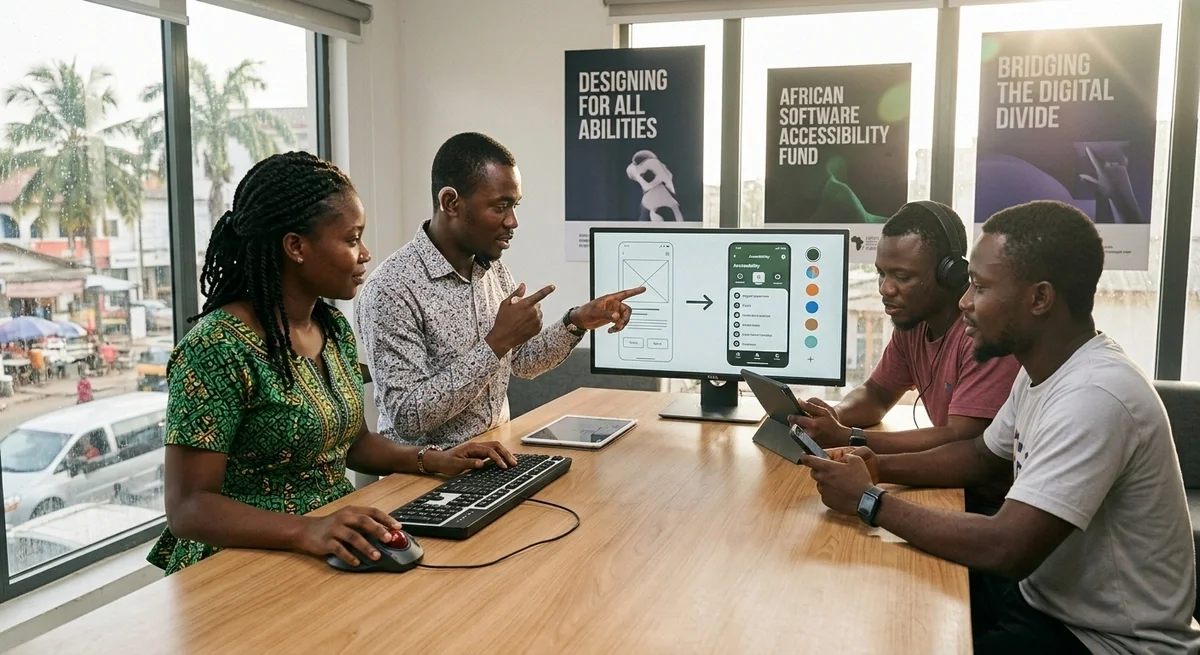
Executive Summary
In Africa, digital technology is growing fast. Governments, schools, banks, and startups are creating apps and online systems to improve education, finance, healthcare, and governance. Yet, most software is not fully accessible to people with disabilities, leaving millions excluded.
This paper shares real stories, challenges, and practical ways to make software more inclusive in Africa.
Introduction
I remember a friend from Nairobi, a visually impaired university student, struggling to apply for a scholarship online. The portal required uploading a scanned form and navigating menus — none of which worked with her screen reader. She had to rely on a friend just to submit her application.
This is not an isolated case. Across Africa, people with disabilities are often locked out of systems that are supposed to serve them. These barriers limit education, work, and independence.
The Accessibility Problem in African Software
Accessibility issues can be grouped into three main types:
Visual Impairments
Example: Some Kenyan mobile banking apps make it almost impossible for blind users to check balances or transfer money without help.
Hearing Impairments
Example: Health education videos on some South African portals provide no subtitles, leaving deaf users without vital information.
Motor Disabilities
Example: In Nigerian schools, online learning platforms rely on drag-and-drop exercises, making it very hard for students with limited hand mobility.
Real Stories from Africa
Education in Kenya
During the COVID-19 lockdowns, online platforms like Tuko Pamoja became vital. But visually impaired and mobility-impaired students struggled because these platforms lacked screen reader compatibility and keyboard navigation. They depended on others just to keep up.
Recommendations for Inclusive Software
Follow accessibility standards:
Use WCAG 2.1 guidelines.
Make software compatible with screen readers, captions, and voice commands.
Include people with disabilities in testing:
Conduct usability tests with blind, deaf, and mobility-impaired users.
Incorporate their feedback early in the design process.
Train developers:
Integrate accessibility into tech education.
Offer workshops for startups and companies.
Government support:
Enforce policies requiring accessibility in public software.
Incentivize private companies to prioritize inclusive design.
Conclusion
Accessible software is more than a feature — it’s a human right. Excluding people with disabilities in Africa limits education, work, and independence. By integrating accessibility from the start, we can create software that works for everyone, empowering people to participate fully in the digital world.

Beautiful piece!